Film Review: "The Conjuring: The Devil Made Me Do It"
Title: The Conjuring: The Devil Made Me Do It (2021)
Director: Michael Chaves
LB Rating: 3/5
The third installment of The Conjuring series takes on the famous Devil Made Me Do It case of Arne Cheyenne Johnson.
As usual, spoilers ahead.
 |
| I always found the Conjuring and Insidious title cards as extremely unnerving. (Image source: empireonline.com) |
From my understanding, there seems to be three thematically distinct parts to the film.
First is the prologue. We find the Warrens attempt to exorcise young David Glatzel. When shtick hits the fan, Arne Johnson begged the demon to possess him instead of David. Which it did.
The exorcism scene gave me little to no scare. Exorcism scenes are cliche in horror films. Speaking as a fan of the horror genre, I am especially accustomed to such scenes. However, I do appreciate the nods to The Exorcist (1973). The contortion of David's possessed body was like an updated version of Regan MacNeil's O.G. possession.
 |
| Tell me that this isn't an obvious nod to The Exorcist. (Image source: seattlerefined.com) |
What intrigued me in the prologue was the concept of "transferred possession". When Arne successfully caused the demon to possess him, I immediately imagined what would be the repercussions to such interaction. Sadly, the film gave nothing about the "transfer." Instead, it built on the "possession." Cliche to still cliche.
Second is Arne Johnson's trial. Some time after the exorcism of David Glatzel, Arne Johnson was overtaken by his demonic visions, leading him to stab his landlord to death. The Warrens convinced the defense attorney to plead not guilty on the ground of demonic possession. This posed the apparent central thrust of the film: the Warrens must substantiate Arne's demonic possession in a court of law.
Once again, we see the clash between logical rationality and the supernatural. This is a basic cliche in supernatural horror movies. After all, people are not expected to passively accept the existence of the ghosts and demons. And so, an appealing direction for horror films is to undermine what logical understanding we have on the world that prevents us from acknowledging the supernatural.
Of particular interest in this film is that the subject of the undermining is the court of law. Judicial courts weigh the scales of justice on the basis of law and factual evidence. There is no room for speculations or beliefs. A conviction is rendered out of facts, not character. It would be interesting how the supernatural would challenge the institution that is incredible of its existence.
(The Exorcism of Emily Rose did this take very well. The film stands as one of my all-time favorite horror movies.)
Unfortunately, Conjuring 3 did not at all present the clash. The time spent by the film in the courtroom felt like no more than three minutes. It had no interest in presenting a trial story. I guess this is expected, seeing that the trial of Arne Johnson appears to be a well-documented part of the legal history of the USA. Any tampering or misdirection would be instantly dismissed, relieving the tension of the film.
 |
| The way Conjuring 3 avoided the trial specifically stated in its title is a big misdirection. (Image source: courant.com) |
The trial was however the excuse for the Warrens to go on their main journey. The plea of not guilty on the basis of demonic possession prompted the Warrens to produce factual evidence of the possession of Arne Johnson. This is the third part. It is the actual main thrust of the film.
The supernatural investigation by the Warrens resulted in the finding that the possession was a product of a curse. David was cursed, and the same was transferred to Arne. It appears that earlier, a different person was cursed in a similar manner. Later, Ed Warren also became cursed. The curse works this way: it forces the afflicted to commit two acts: first is to kill another, and finally, to commit suicide.
This brought the Warren to ex-priest Kastner. During his stint as a priest, Kastner was deeply involved in the study of the occult due to his involvement in the Disciples of Ram controversy (found the link to Annabelle).
But the real revelation, which was made much later into the film, was that it was Kastner's occultist daughter who was the mastermind behind everything. Shadowing Kastner, his daughter also became obsessed with the occult. However, unlike Kastner, his daughter was yet to have a proper moral framework when she entered her obsession at a young age. She was unable to distance herself from the study of the occult. Instead of studying the occult from a detached POV, she integrated the occult into her goals and aspirations. What resulted is an adult witch whose life is dedicated to the performance of demonic rituals. Yikes.
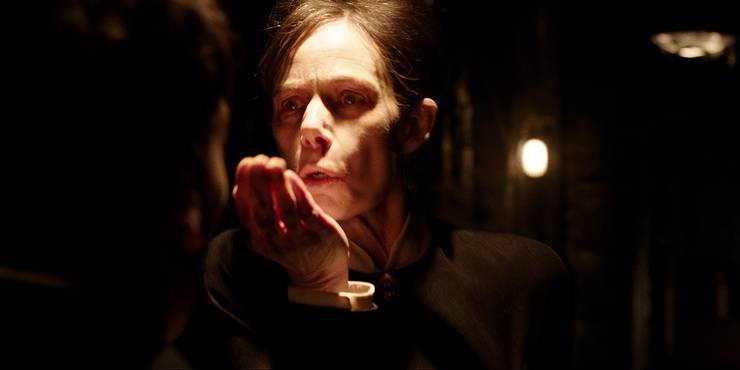 |
| The occultist gives off The Omen nanny vibes. (Image source: screenrant.com) |
Hence, the primary pondering of Conjuring 3: How does one investigate the darkness of humanity? Conjuring 3 presents the Warrens as the blueprint.
The most notable trait of the Warrens is that they have established a support system with each other. The Warrens rarely act individually because of their reliance on their dynamic. Lorraine serves the psychic role while Ed maintains the physical side. When Lorraine is within her trance, Ed protects her physical body. He would also pull her away if she goes in too deep. Ed, in contrast, would not really get anywhere without Lorraine's capabilities. The only way for the Warrens get through the paranormal mysteries is together.
Another important distinction is that the Warrens has a relationship outside their demonology job. Lorraine and Ed are not just the psychic and the sidekick. respectively. The Warrens are in a proper relationship founded in love and trust. Because of this, they are connected by a strong bond which acts as a shield against evil forces. As the film showed, even the influence of evil cannot force Ed to murder Lorraine.
 |
| It's cheesy but Conjuring 3 is basically saying that love overcomes evil. (Image source: slashfilm.com) |
A stark contrast is created with Kastner. The ex-priest raised his daughter alone. He had no support system, and no love or trust as protection. He was basically alone, juggling between his study on human evil and his role as a father--both nowhere near easy. In this film, it was ambiguous whether his study got anywhere, but it is blatantly shown that he failed as a father. Whatever evil he was trying to prevent was reborn in her daughter.
I think that this dichotomy between the Warrens and Kastner, vis-a-vis the investigation of humanity's darkness, is quite enlightening. It doesn't take much for one to embrace their evil side. Any mild-mannered person can go ape-shit angry on a particularly bad day. This is all the more true when your career is one in the pursuit of truth in the darkest sides of humanity. You would have to live through the bad days of people to see what they see and to understand their actions--all while also resisting the influences that made them evil in the first place.
It's essentially like being an undercover cop going deep into the mafia. Conjuring 3 posits that to avoid going Adrian Pimento while on the job, you must have a support system built on pure love and trust. Without that, you're naked. Even your children would not be safe.
Sinister (2012) also dealt with this issue, but instead of positing a solution like Conjuring 3, it focused more on the corruption of children. But let's not preempt my future review on Sinister.
With that said, I would argue that Conjuring 3 is not at all trying to be a pure horror experience. The Conjuring series is at this point where it is no longer motivated to scare our pants off, like it was at the first film. Horror is still the centerpiece of the series, but in Conjuring 3, it is now also comfortable in covering the other emotions attached to it.
In this case, Conjuring 3 had no problem exposing the romantic connection between Ed and Lorraine. In fact, while I took most of the horror elements in the film as nowhere near a terrifying experience, I found most of my enjoyment in the Ed-Lorraine dynamic. Especially the scene in the end when Lorraine handed Ed his hypertension medicine. It's like seeing an old couple in the fast food chain they have went to for decades. Touching stuff!
 |
| Kilig! (Image source: weheartit.com) |
Overall, I liked Conjuring 3. It is not a scary experience, nor did it tackle heavy questions that were teased in the beginning. However, the Ed-Lorraine dynamic made me feel things and it was fun to watch.
Comments
Post a Comment