Film Review: "Deliver Us From Evil"
Film title: Deliver Us From Evil (2014)
Directed by: Scott Derrickson
LB Rating: 3/5
Deliver Us From Evil is a standard horror story where logic and the supernatural is pitted against each other. The protagonist Sgt. Ralph Sarchie embodies the close-mindedness of an arrogant rational man, with typical lines like "I've outgrown religion" or "the devil is a fairytale." Sarchie keeps this facade confidently, but inside he feels a lot of uncertainty and fear about something he cannot rationalize. Sarchie represses these feelings ineffectively, as they seep into his family, creating between them some cold distance. The events of Deliver Us From Evil help Sarchie unpack his fears and face them head on.
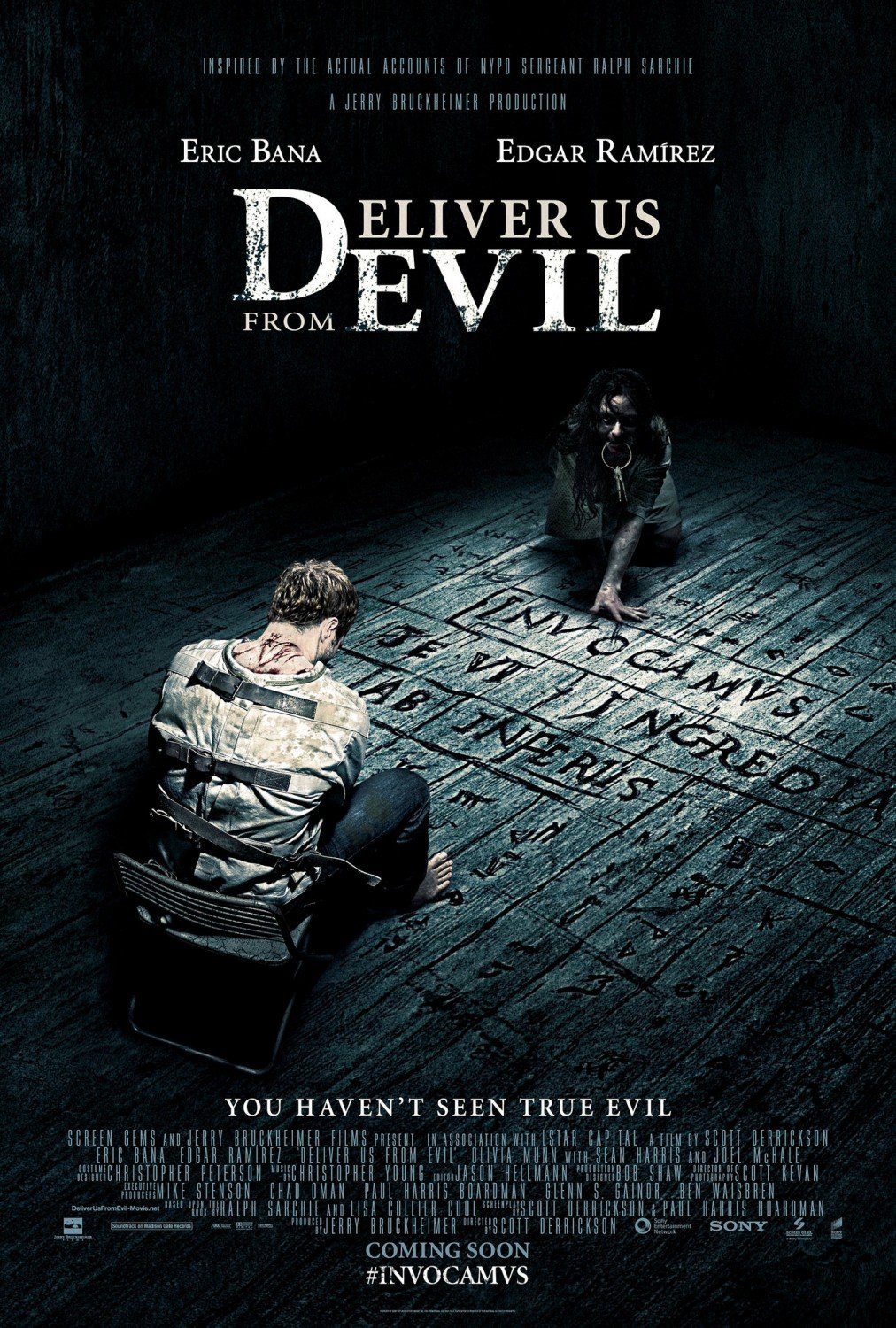 |
| I don't think the film actually shown true evil. (Image source: imdb.com) |
The story opens with Sarchie lost in his thoughts as he revives a baby but already too late. The film uses a lot of sneaky metaphors that work really great. This opening scene for instance pertains to Sarchie's unforgiven sin and his futile attempts to resolve them. He loses himself, unable to see that it is too late and he must move on. This actually typifies the entire story.
Subsequently, Sarchie gets himself involved in a string of crime mysteries. Immediately, he uses his purely logical analysis to come up with an explanation but to no avail. Even as he finds more pieces, he could not make the connection with his logical tools. His past police work experiences could not help him explain what he is seeing: a mother throwing her son into the zoo, a person watching his friend commit suicide, unapologetic domestic violence... His proud tool of logic could not break open these grotesque events.
 |
| If you see a wall of cryptic graffiti, just get a priest involved.(Image source: thebookthefilmthetshirt.com) |
And so Sarchie meets Father Mendoza, the priest-exorcist. In the film, Father Mendoza is blatantly unconventional. Despite being a devout priest, he drinks, he smokes, he looks at asses, etc. Mendoza embodies what I call the damaged hero archetype.
For me, the damaged hero is the character who won the battle with their inner demons before he/she acquires the tool to defeat extrinsic evil. Batman is a damaged hero, because he had to understand the grief and fear of losing his parents before he emerged as a crime-fighting vigilant. This is starkly in contrast with Superman or Goku, whose morality are pure and uncompromising, and so the evil adversary are always extrinsic.
In a more religious setting, Jesus also is a damaged hero in the sense that he is a god inside a mortal body. Jesus had to overcome the frailty of the mortal body by avoiding temptation, experiencing betrayal, and ultimately sacrificing himself via crucifixion. He emerges victorious over death through his iconic resurrection, placing him in a glorified status as the savior of all men.
What's the literary purpose of the damaged hero? This character opens an alternative path to greatness. Arguably, this is best path to greatness because being purely good like Superman is simply unrealistic. A human has to deal with his inner evil and emerge victorious. Only then will the human become better armed against the uncertainty of the world.
Father Mendoza is exactly the damaged hero. He is exaggeratedly depicted as such, to the point of parody. Mendoza is a drug addict who turned into a priest. The unexpected exaggeration is that even as a priest, Mendoza relapsed and got into a sex-crazed high with a married woman. Mendoza not only had to overcome his drug addiction, but also the amplified version of drug addiction. This made him the invincible badass priest-exorcist.
 |
| Why do people think that adding drinking and smoking instantly badass-ifies a character? (Image source: filmgeekguy.com) |
What has this got to do with Sarchie? It is revealed later in the film that Sarchie's burden has to do with his unexpected behavior when he apprehended a pedophile in action. Driven by anxiety, as he was at the time a father of a young daughter, he pummels the pedophile to death. Sarchie became conflicted with a heavy moral question. Did he do good in ridding the world of a despicable human being? Or did he go too far in assuming justice in his fists? The inability to resolve this moral dilemma renders Sarchie unable to incorporate into his own identity the person he was when he relentless hammered the helpless perpetrator. Ultimately, he felt possessed by a foreign spirit. Hence, the exorcist.
This is where the straightforward moral underpinning of the film becomes weak. Mendoza's secret answer is to submit to confession and repent. With all that set up, this solutions feels too conventional and predictable. Mendoza had to battle his demons twice to come up with that solution? Even a priest who had everything straight knows that! The opportunity felt wasted.
 |
| I
still can't believe that they became uber vulnerable with each other
after a few drinks. But I am totally like that. (Image source:
aconstantlyracingmind.com) |
And so that is what they did. Oddly enough, after these grown men meet for, like, the third time, Mendoza started sharing his entire biography and convinces Sarchie to do the same. After a cheesy fade to white, Sarchie emerges fully integrated. He even helps Mendoza perform a crazy and unconventional exorcism. Down the line, Sarchie apparently becomes religious. His problems with his family appears to have been solved too.
No doubt, there is definite merit to confession and repentance as effective tools in integrating the personalities within an individual. They involve a lot of serious self-reflection to extract, almost always painfully, the lesson from past mistakes. What disappoints me with this film is that this solution is too conventional for the clear parody-like metaphor of madness the film used as a premise.
The film presented a crime mystery, the key of which can only be found if the protagonist solves his compelling internal moral dilemma. An unconventional priest-exorcist enters the play to help him extract the answer. But the answer extracted is quite boring. Everything works out in the end.
Had the film presented an unconventional solution to match its compelling set up, the film could have easily reached the 4/5 territory. Nonetheless, the film is quite enjoyable. Deliver Us From Evil gets a solid 3/5.
Comments
Post a Comment